Holiday lights By Terry McCarthy, publisher of Nashville Home Pros Magazine · November 6, 2026 · 5 min read
One holiday attraction at Gaylord Opryland has used more than 2 million pounds of ice. The resort’s page for its 39th annual A Country Christmas gives the rest of the job: 1,000 tons in all, 40 artisans carving for thirty days, about 20,000 square feet of it at a 2,888-room resort. Then, on the Magnolia Lawn, a ceremony to light “more than 4 million holiday lights.”
That count is from the 39th edition, and the page prints no year. We couldn’t open the resort’s page for this season, so we’re leaving this year’s figures to the resort.
How big this place goes
Cheekwood’s number is current. Holiday LIGHTS runs November 20, 2026, to January 3, 2027, with “more than a million twinkling lights” along a “one-mile walking path,” a 28-foot Pixel Pine over the Bradford Robertson Color Garden and the Dancing Lights of TRAINS! Admission starts at 4:30 p.m., and a daytime ticket doesn’t cover it.
Downtown, Metro’s official tree lighting is at Public Square Park, 10 Public Square. The most recent lighting Metro’s page shows is December 6, 2024, at 6:00 p.m., with a toy drive. We didn’t find the 2026 date.
The light counts are the owners’ own. We found no outside tally of them, and no study of why this area lights up the way it does. What the agencies do count is what happens at home.
The number that belongs to the ladder
The U.S. Consumer Product Safety Commission says about 160 people a day are hurt decorating for Christmas during the holiday season, and nearly half of those injuries are falls. For the season it calls 2023, running November 1, 2022, to January 31, 2023, it counted about 14,900 emergency room visits for holiday decorating injuries. That’s the latest figure its 2025 release gives.
About 160 home fires a year start with a Christmas tree. About 160 people a day get hurt decorating.
Those two figures come from different agencies and different years, and the match is a coincidence. The gap between a year and a day isn’t. Decorating injuries are the far more common trouble.
Thirty feet, or thirty-five
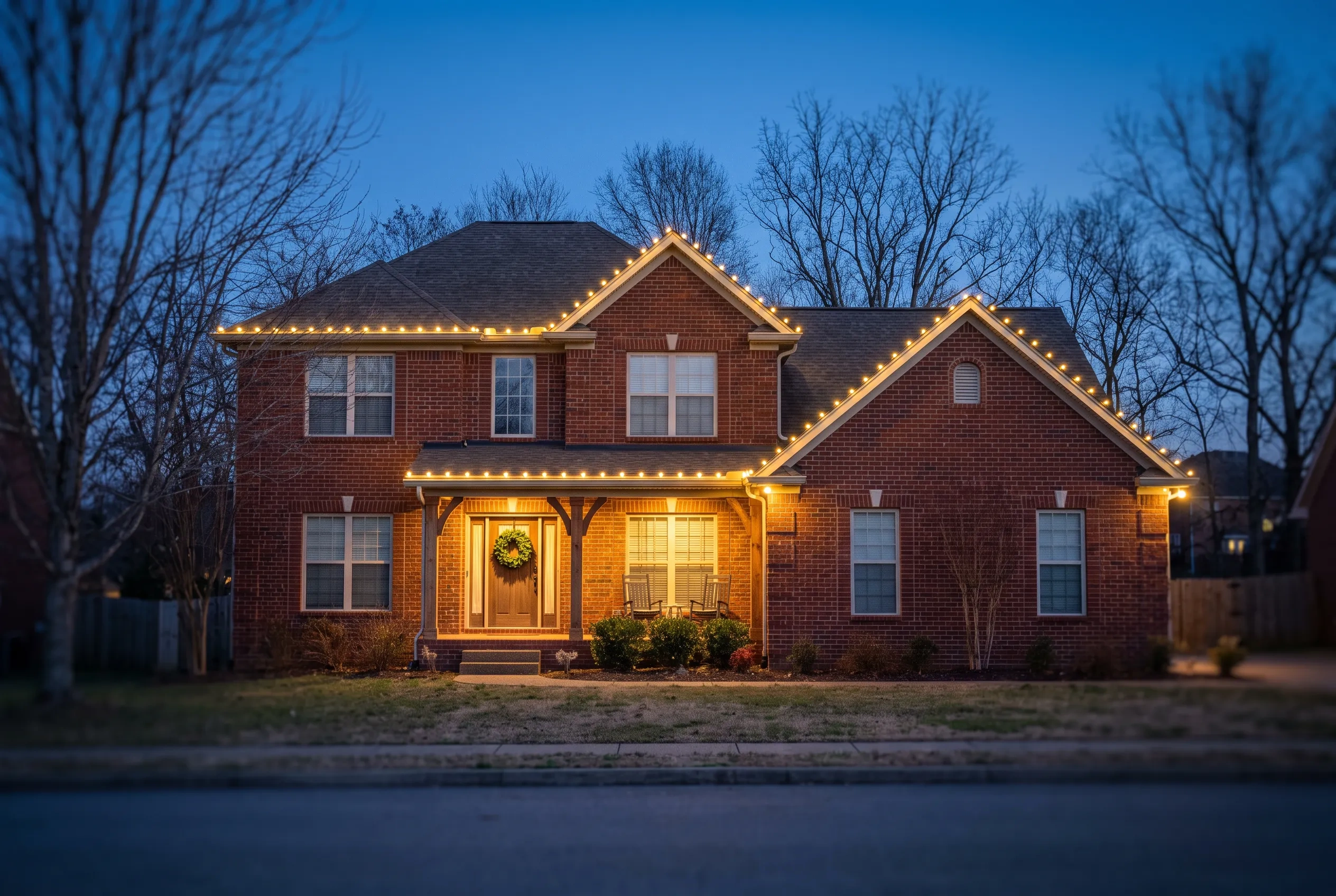
A ladder at the eaves is also a ladder near the wires. Nashville Electric Service says to stay at least 30 feet from power lines, to assume every wire is live, and to look up before moving a metal ladder. Another section of the same page says 35 feet, so the longer distance covers both.
Trees take more thought. NES’s tree page, updated June 7, 2026, says clearance between poles and line corridors has expanded to 15 feet with no overhang. It doesn’t remove trees near service lines: “The homeowner is responsible.” It will disconnect service at no cost so a private tree company can work, and any arborist within 10 feet of an energized line needs OSHA Line Clearance Arborist Certification.
We looked for a Metro or NES rule on hanging lights from poles or in trees near lines and didn’t find one we could read. And NES speaks for NES customers. If your bill in Spring Hill or Lebanon comes from another utility, ask that one.
What the tree fires show
The National Fire Protection Association’s report, drawn from 2016 to 2020, is the latest we could read. It counts an annual average of about 160 home fires that began with Christmas trees, along with 2 civilian deaths, 11 injuries and $12 million in direct property damage. Those fires are under 0.1 percent of reported home fires.
The timing is narrow. Three-quarters happen in December or January and half between 3 p.m. and midnight, and 41 percent started in a living room, family room or den. Electrical failure or malfunction (34 percent) and heat sources too close (20 percent) led more than half.
Electrical distribution or lighting equipment was involved in 44 percent: lamps, bulbs or lighting 19 percent, wiring 19 percent, cords or plugs 6 percent. The report’s caution on natural trees is about time, since the longer one stays up, the likelier it is to dry out and ignite.
That report covers trees. We found no NFPA report on outdoor string lights separate from it, so we can’t give you a number for the eaves.
What a strand costs to run
The U.S. Department of Energy says LED strands “consume 70 percent less energy” than conventional incandescent ones. Its example is a 6-foot tree lit 12 hours a day for 40 days: $0.27 with LEDs, $10 with incandescents. The page carries no date, so read those dollars as older prices and the gap as the point. We found nothing from TVA or NES on holiday lighting and energy use.
Before you carry the boxes out
Each line below links to the agency or the owner that said it, whether you’re hanging lights in Smyrna or Mt. Juliet.
Sources
- Gaylord Hotels: ICE! at Gaylord Opryland Resort
- Cheekwood: Holiday LIGHTS
- Cheekwood: Know Before You Glow
- Metro Nashville: Metro Nashville Christmas Tree Lighting
- National Fire Protection Association: Christmas Tree Fires (Richard Campbell, December 2022)
- U.S. Consumer Product Safety Commission: Happy Holidays Start with Safety (2025 news release)
- U.S. Department of Energy: How Do Holiday Lights Work?
- Nashville Electric Service: Electrical Safety at Home
- Nashville Electric Service: Tree Trimming
This story runs online only. Every fact in it is linked to the page it comes from, read on November 6, 2026. See something that has changed? Send us a note.