Concrete By Terry McCarthy, publisher of Nashville Home Pros Magazine · November 6, 2026 · 5 min read
There is quartz in the concrete on Nashville’s Parthenon. Only a small amount went in, and the building’s National Register nomination gives the reason: “to remove any suggestion of lifelessness.”
Marble was too expensive, the nomination says, so the concrete had to look like the weathered marble of Athens. How the city came to that starts with a fair building that was supposed to be gone when the fair was.
A fair building made for one season
The first Parthenon went up for the Tennessee Centennial Exposition. The building’s own history puts the first foundation stone in 1895 and the fair at May 1 to October 30, 1897, with about 1.8 million visitors.
The records differ a little on what those visitors were looking at. The Parthenon’s site says “plaster, wood and brick.” The nomination says Robert T. Creighton built it of wood and plaster for $30,000, stucco outside and plaster within. The Parthenon’s site is blunt about how the skin held up: the exterior coating, the sculpture and the decoration “soon deteriorated.”
In 1915 the pediment sculptures were removed “for safety reasons.” The fair had been over for 18 years and the building was still standing. The nomination closes that chapter in one line:
“Built in 1897 to last one season, it was finally beyond repair in 1920.”
The city picks concrete
In 1920 the city, as the Parthenon’s timeline has it, “decides to make the Parthenon a permanent aggregate concrete structure.” Local architect Russell Hart led the job. The Tennessee Encyclopedia names Foster and Creighton as the contractors. The nomination names Wilbur F. Creighton Sr., son of the 1897 builder, as working with Hart, and says he “spared no money or effort.”
How much of the old building sits inside the new one depends on whom you read. The Parthenon’s site says the 1897 brick walls and non-load-bearing columns were built in, with the roof, the expanded walls and the load-bearing columns in reinforced concrete, “the novel new building material of the twentieth century.” The nomination says everything was razed except the stone foundations and the brick walls around the cellar, and that the column foundations were strengthened. The dates move around too: 1920 for the decision, 1921 to 1931 on the timeline’s architecture line, eleven years by the nomination’s count.
A formula meant to pass for marble
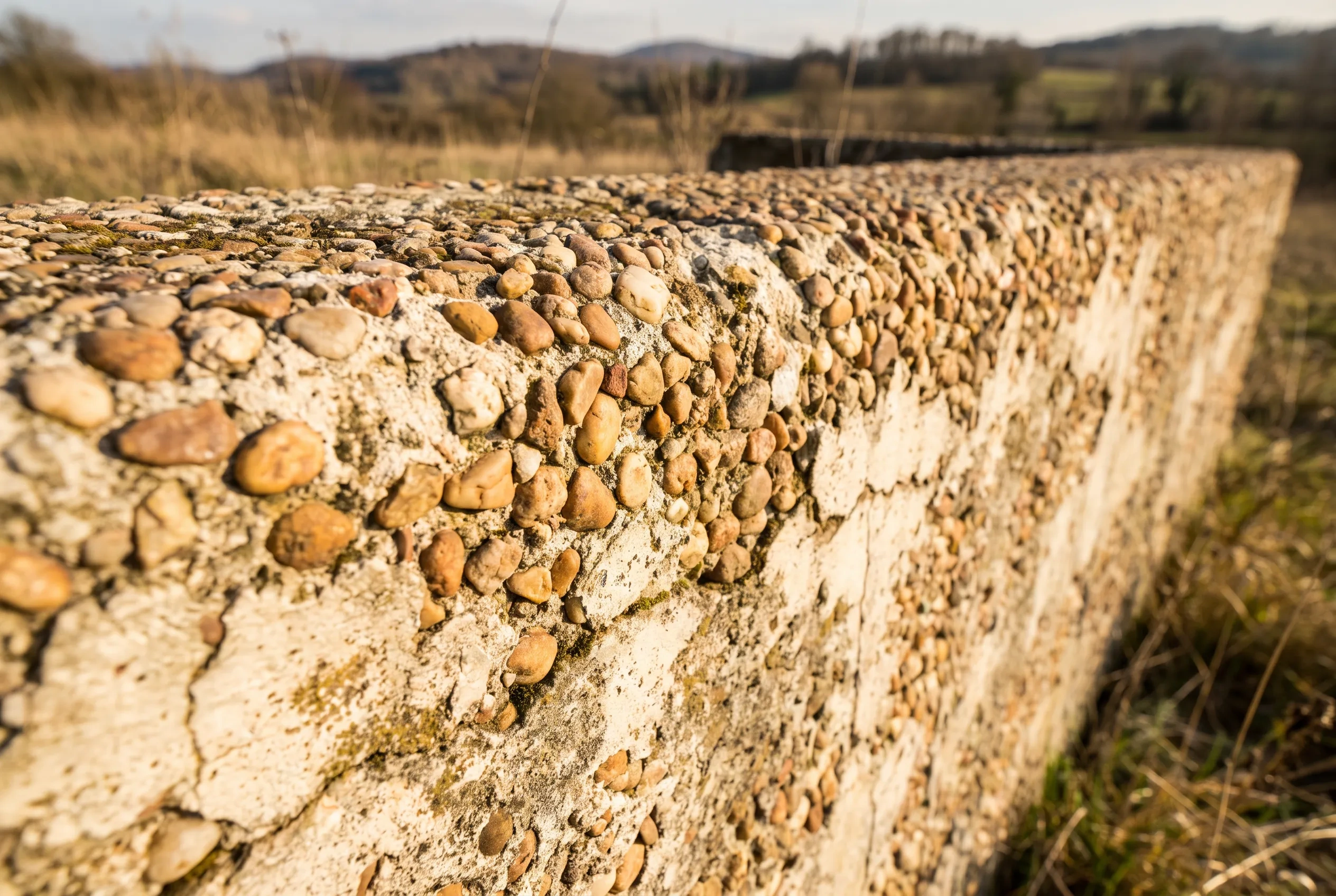
Hart chose a cast concrete aggregate, using “a formula developed by John Earley” for all the exterior surfaces, the roof tiles, the decorative work and the sculpture. Earley, born in New York City in 1881, had opened an office and studio with Basil Taylor by 1907. In 1916, the National Park Service says, he built a full-size mock-up wall for Meridian Hill Park in an aggregate concrete he called “architectural concrete.” Cass Gilbert suggested the texture, the Park Service writes, but “it was Earley who figured out how to accomplish it.”
The nomination spells out the Nashville mix. Equal parts white and grey cement went in, with a fine aggregate ground from the same material as the coarse, “to gain a uniformity in tone and color.” Then came the quartz.
Belle Kinney and Leopold Scholz made the permanent pediment figures and George Julian Zolnay the Doric metopes, the encyclopedia records, and casts of the original marble fragments were bought from the British Museum. The nomination adds that Earley’s studio in Washington made casts of the sculpted figures.
The building runs 228 feet long, 101 wide and 65 high in the nomination’s figures, with columns about six feet across at the base and steps that rise nine inches at their center to offset apparent sag. The same form claims the dimensions were copied “to a thousandth of an inch.” That is its claim, and we couldn’t check it.
Finished in pieces
The exterior was complete in 1925, and the building reopened as a city museum on May 20, 1931, still missing its Athena and the Ionic frieze outside. The Park Board commissioned Alan LeQuire in 1982. His 42-foot statue took “almost eight years” and was unveiled on May 20, 1990, 59 years to the day after the reopening. Gilding began June 3, 2002.
What the record leaves out
A fence went up in 1991 as restoration began, and the history page calls the work complete with a celebration on December 31, 2001.
We went looking for what those ten years repaired, how Earley’s formula had weathered and what the work cost. The Metro Parks and National Park Service pages we read don’t say, and the cost of the 1920s rebuild didn’t turn up in them either.
Why concrete fails, by the Park Service
The Park Service does explain the general case. Its Preservation Brief 15, “Preservation of Historic Concrete” by Gaudette and Slaton, traces deterioration mainly to corroding steel inside the concrete, degradation of the concrete itself, improper materials or structural problems.
The steel part is chemistry. Embedded steel is protected while the concrete stays alkaline, above pH 10, and carbonation is what lets corrosion begin. The water part is simpler. Saturated concrete that freezes cracks and delaminates, worst “at joints, architectural details” and exposed spots, and poor roof and drainage maintenance feeds it. On exposed aggregate, the brief’s own words: “Different levels of aggregate exposure due to paste erosion” are often found.
The brief also says air-entrained concrete came along in the second half of the twentieth century. The Parthenon’s exterior was done in 1925. Nothing we read connects those dates to this building.
The brief is written for historic structures, and a driveway in Hendersonville or a patio in Bellevue may be neither. Applying it to a slab is our reading of it, not its instructions, and these steps go only as far as its words.
Sources
- Nashville Parthenon (Metro Parks): About the Parthenon
- Nashville Parthenon (Metro Parks): History
- National Park Service: National Register of Historic Places nomination, the Parthenon (NRIS 72001236)
- Tennessee Encyclopedia: The Parthenon
- National Park Service: John J. Earley
- National Park Service: Preservation Brief 15: Preservation of Historic Concrete
This story runs online only. Every fact in it is linked to the page it comes from, read on November 6, 2026. See something that has changed? Send us a note.