Masonry By Terry McCarthy, publisher of Nashville Home Pros Magazine · November 6, 2026 · 5 min read
Lewis, Daniel, Robert, Nelson, John, Parker, Dang, Bill, John G., John, Andrew, Jim.
Those are the twelve names recovered from a group of fifteen enslaved men the State of Tennessee rented to quarry limestone and carve the cellar of its new Capitol, according to House Joint Resolution 318 and House Joint Resolution 152, both from the General Assembly in 2025. They worked from the spring of 1846 to January 1847. The other three names aren’t on the list.
A limestone hill and a tight budget
The cornerstone went down on July 4, 1845. William Strickland had the design and supervised the work. The Capitol Building Commission, “adhering to the strictest economy,” required solid limestone “quarried directly from the construction site,” Resolution 318 says. The National Park Service nomination says “quarried nearby” instead. We couldn’t find a name or an owner for the quarry in either.
What was under the hill wasn’t in doubt. Resolution 152 describes rock with only “a thin layer of soil” on it. That thin soil has a story of its own: why the shovel hits rock here.
Fifteen men, picks and crowbars
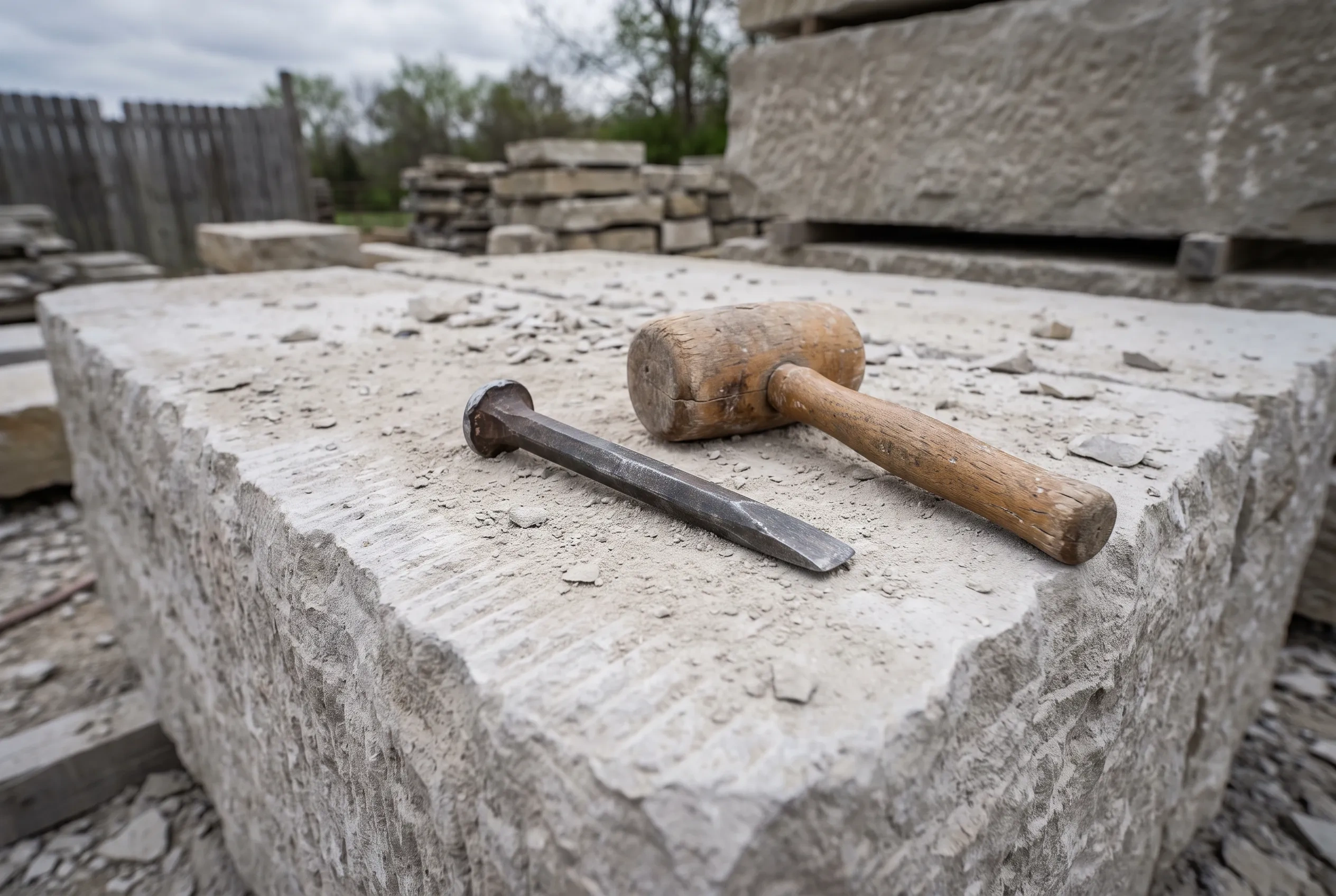
Once the soil was off, the fifteen went at the rock “using picks and crowbars” and moved it on flatbed wheelbarrows. The Tennessee State Museum says enslaved workers flattened the rounded hill for the foundation, excavated the crypt and helped quarry “the large limestone boulders” that were shaped at the state penitentiary.
The state’s money went to A.G. Payne, a Nashville stonemason: $18 per month per man, which the resolutions call “more than double the typical rate” and nearly double the rate for unskilled free labor.
When the cellar was done, the men remained in slavery, 14 years with Payne on his farm and at his brick factory, then with his widow, until emancipation in 1865. By that account they were still enslaved when the building was finished, and for six years after.
The prisoners and the stonecutters
The General Assembly also authorized prison labor for the quarrying. Among those prisoners, Resolution 318 counts as many as ten “good stonecutters” and another twenty who “had some experience.” The museum says convicts held at the penitentiary broke and quarried stone too. Blocks of six to ten tons were hoisted into place, the nomination says, limestone with shells and fossils “plainly discernible.”
Who did the finest cutting depends on the source. The nomination credits much of the skilled stone cutting to convict labor. Resolution 318 gives the decorative carving to a few skilled immigrants, twelve Irishmen, five Germans and one Frenchman, who had worked on the North Carolina State House under David Paton.
A docket from July 10, 1854, lists 52 stonecutters. Eight had Irish names, five German or Prussian, seventeen British Isles. Five are identified as “Negro,” and the resolution gives them by name: Martin Moor, Arch Young, Ivy, Duke and Spencer. Contract records now name some workers, the museum says.
Two men in the wall
Strickland died in April 1854 with the job unfinished. “He asked to be buried inside the wall,” the State Museum’s page on him says, and it places him in the northeast corner; the museum’s Capitol page says the north facade. His son Francis stayed on as architect for three more years. The last stone went into the tower cupola on July 21, 1855, and the commission dismissed Francis in 1857.
Samuel Morgan is in the southeast wall. A single museum page says he helped finish the building, gave “a lot of his own money” to the state, and that his family wanted him given the same honor when he died in 1880.
The Capitol was finished on May 19, 1859. “It took fourteen years and cost $879,981.48,” the museum says, about three times what was expected. The 1970 nomination has it done nine years after it was begun; the museum, the encyclopedia and the resolution all say 1859.
The 2025 resolutions ask the state to honor the enslaved workers and to name an entrance at the Motlow Tunnel the Heritage Gateway Entrance. We didn’t confirm whether they passed.
The stone that had to come off
By 1902, 43 years after completion, the state was making “some repair” to stonework that the nomination says “was weathering badly.” Then came no significant repair until 1956, though the deterioration “was a concern of every governor and general assembly.”
The contract that began in January 1956 replaced 90,000 cubic feet of limestone. It took all 28 Ionic columns, each four feet across and 33 feet high, along with the pediments and parapets, the whole entablature, the cornices, the upper and lower terraces and the tower columns. The new stone was oolitic limestone from Indiana, with exact templates of every piece. The museum’s caption says the Winfrey Brothers Company of Knoxville was subcontracted to set it, with multi-ton cranes doing the lifting.
It finished in 1960, “looking almost exactly as Strickland left it,” the nomination says. We couldn’t find what the stone work cost.
What that says about an old house here
Be careful with this part. The nomination doesn’t say why the stone failed, and nothing we read about the Capitol speaks to houses. It can’t diagnose a stone foundation in Franklin or an old wall in Gallatin. It does offer a dated example of limestone weathering and of how one owner replaced it, and these steps stay inside that.
The columns the 1956 contract put up are Indiana stone. The hill under them is the one Lewis, Daniel, Parker, Dang and the rest cut into.
Sources
- Tennessee General Assembly: House Joint Resolution 318, 114th General Assembly
- Tennessee General Assembly: House Joint Resolution 152, 114th General Assembly
- Tennessee State Museum: The Tennessee State Capitol Through Historic Images
- Tennessee State Museum: State Capitol
- Tennessee State Museum: William Strickland, the Capitol’s Architect
- Tennessee State Museum: A Tour Through the Capitol, Part 1
- Tennessee Encyclopedia: Tennessee State Capitol
- National Park Service: National Historic Landmark nomination, Tennessee State Capitol
This story runs online only. Every fact in it is linked to the page it comes from, read on November 6, 2026. See something that has changed? Send us a note.